
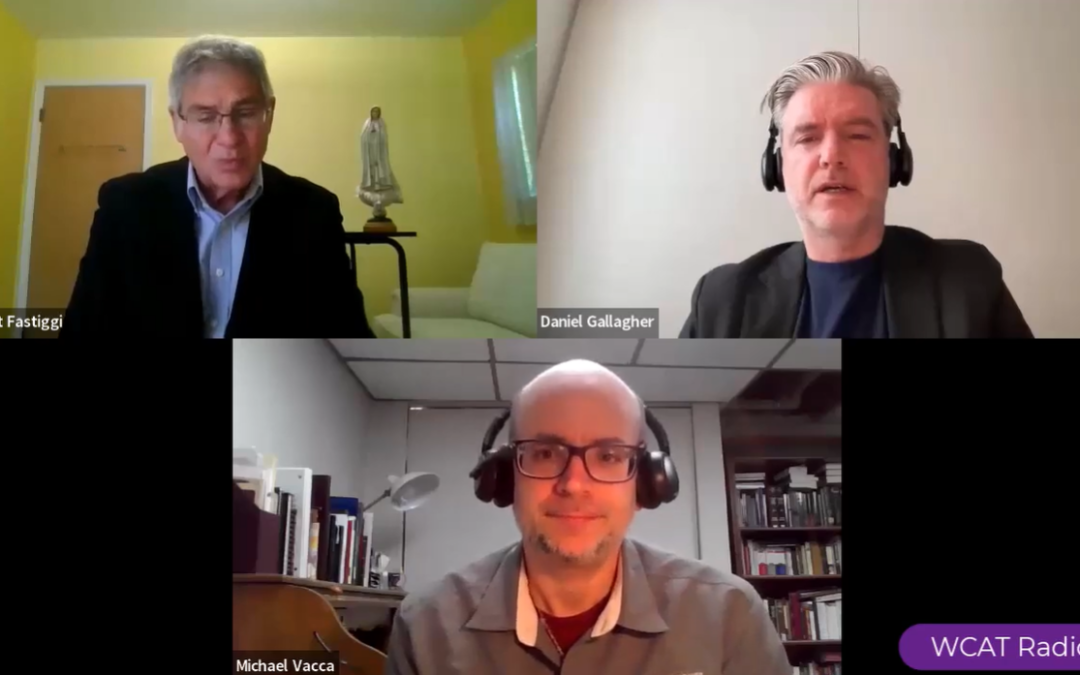
In this episode of "The Social Doctrine of the Church," Michael Vacca and Robert Fastiggi interview Prof. Daniel Gallagher about Pope Francis' encyclical Fratelli Tutti. They don't shy away from the controversial statements on private property, the death penalty and how the encyclical meshes with the rest of the Church's social doctrine.
Questions they address include:
- How does Pope Francis’s 2020 encyclical, Fratelli Tutti, align itself with social encyclicals of prior popes and how is it unique?
- Why do you think Pope Francis issued this encyclical?
- In chapter one, Pope Francis speaks of “dark clouds over the world.” What are these dark clouds and what does Pope Francis offer by way of hope?
- In chapter two, Pope Francis reflects on the Parable of the Good Samaritan. What does he believe this parable teaches us today?
- In chapter three, no. 120, Pope Francis generated some controversy with the statement: For my part, I would observe that “the Christian tradition has never recognized the right to private property as absolute or inviolable, and has stressed the social purpose of all forms of private property”. How does this reconcile with the rest of the Church's teachings on private property?
- In Fratelli Tutti, Pope Francis offers some thoughts on war and the death penalty. Why have his positions on war and the death penalty generated so much controversy?
- You published an article criticizing Fratelli Tutti for not being sufficiently Christocentric? What did you mean by this criticism and how does it relate to how Pope Francis describes the encounter of St. Francis of Assisi with The Egyptian Sultan, Malec-el-Kamal?
- Pope Francis ends Fratelli Tutti with an ecumenical Christian prayer. Does this not show a Christian inspiration to the encyclical? 9. How would summarize the strengths and weaknesses of the encyclical?
An audio version of the podcast is available here.